
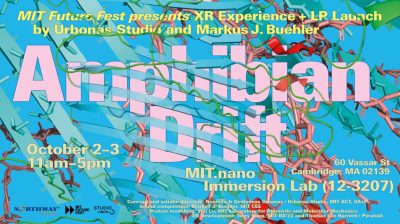
World premiere of the Amphibian Drift
Nomeda & Gediminas Urbonas with Markus J. Buehler
Inaugural MIT Future Fest
October 2-3, 2026, 11am – 5pm
MIT.nano Immersion lab (12-3207)
60 Vassar Street
Cambridge, MA 02139
An immersive XR journey into the hidden music of a caddisfly protein, Amphibian Drift was conceived by Nomeda & Gediminas Urbonas in collaboration with material scientist Markus J. Buehler, with XR development by Terry Kang and Thomas Lee Harriett / Pyraloid. Commissioned by the MIT Museum and supported by Northway Biotech and MIT.STUDIO.nano, the work will have its world premiere at the inaugural MIT Future Fest, October 2–3, 2026.
Created for the inaugural MIT Future Fest, Amphibian Drift is a multi-user XR environment by Nomeda and Gediminas Urbonas in collaboration with material scientist Markus J. Buehler, developed with MIT.nano and XR developers Terry Kang and Thomas Lee Harriett / Pyraloid. The work transforms the molecular structure and vibrational behavior of a silk protein produced by Hydropsyche caddisfly larvae into a navigable field of image, sound, movement, and spatial interaction. Rather than presenting the protein as a scientific object to be viewed from the outside, Amphibian Drift invites participants to enter its structure, move through its acoustic and molecular organization, and encounter it across changing scales.
Caddisfly larvae inhabit moving freshwater environments, where they spin underwater silk structures that function as filtering nets and contribute to the material organization of aquatic ecosystems. At the center of Amphibian Drift is a three-dimensional model of one of the proteins contributing to this remarkable material practice. Characterized through molecular modeling and dynamic analysis at MIT’s Laboratory for Atomistic and Molecular Mechanics, the protein becomes the point of departure for an artistic experiment in how scientific information might be translated across scales and sensory registers. Molecular structure is therefore not treated simply as an image or diagram, but as material for a spatial composition in which vibration, sound, movement, and perception become interconnected.
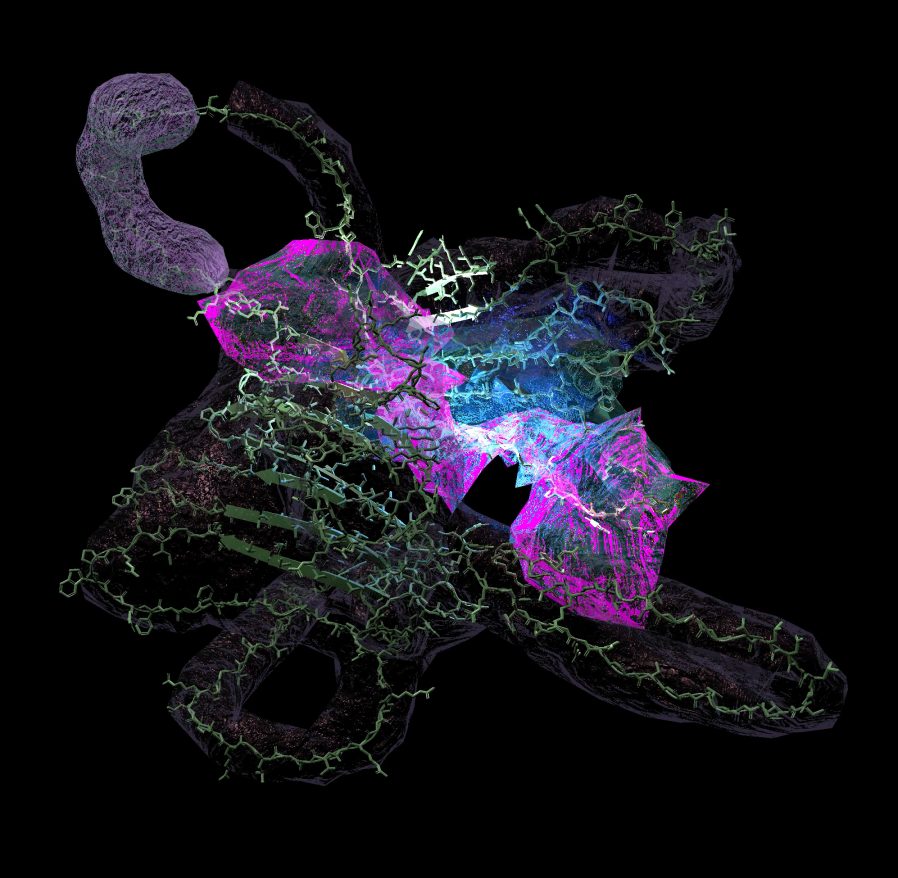
The work emerges from a broader question: what happens when scientific models are not only observed, but inhabited? Scientific modeling necessarily relies upon abstraction, measurement, computation, and representation in order to render processes occurring beyond ordinary human perception intelligible. Amphibian Drift does not attempt to replace those modes of knowledge. Instead, it asks what another form of access might produce when the model becomes a site of bodily encounter. The scientific object is translated into an artistic environment in which participants learn through position, proximity, orientation, rhythm, and action. In this sense, the project shifts from representation toward transduction: molecular and computational phenomena are translated into sensory fields that can be navigated, heard, and physically negotiated.
Sound is central to this process. Markus J. Buehler’s research has developed methods for translating molecular structures and vibrations into audible frequencies, revealing relationships between material organization and acoustic form. In Amphibian Drift, this research becomes spatial. At the heart of the experience is Buehler’s composition The Elegy of Motion, derived from the vibrational behavior of the caddisfly protein and artistically developed into a layered sonic work. Rather than remaining a fixed soundtrack, sound is distributed through the three-dimensional molecular environment. Participants encounter different sonic relationships according to where they stand, how they move, and how they interact with the structure. Sonification thus becomes not only something to listen to, but something to drift through.
The experience unfolds as a choreography of scales. Participants first encounter amino acids as responsive sonic entities that can be touched, moved, and assembled. Their interactions begin to disclose relationships between molecular sequence, structure, and sound. These elements subsequently gather into the larger protein configuration, transforming what initially appears as discrete molecular fragments into a room-scale structure. The protein becomes an acoustic architecture: a branching, vibrating form through which participants can move as the composition unfolds. The perspective then expands again. A single protein becomes one among many, dispersed through the environment until sound surrounds the participants as a spatial orchestration. Finally, the molecular field reconnects to the biological scale from which it emerged, resolving toward the silk structures produced by the caddisfly larva. The experience therefore travels from amino acid to protein, from protein to multiplicity, from molecular vibration toward silk, organism, and environment.
The body is fundamental to this translation. Research into embodied media has argued that interactive environments can produce different forms of understanding precisely because perception is inseparable from action: we encounter the world not as disembodied observers but through bodies that move, orient, reach, listen, and respond. The significance of embodiment is therefore not that it necessarily produces a “deeper” knowledge than scientific representation, but that it opens another epistemic register. In Amphibian Drift, the body becomes an instrument of inquiry. Participants discover relationships through gesture and consequence, through changing distance from a sounding structure, through shifts in scale, and through their encounters with other participants occupying the same computational field.
This is also why the work is conceived as a multi-user environment. Participants do not enter isolated simulations but share a synchronized spatial condition. Their movements coexist within the molecular-acoustic space, repositioning knowledge as relational rather than purely observational. The participant becomes simultaneously listener and navigator, while meaning emerges through an ongoing exchange between molecular data, computational behavior, bodily movement, and the actions of others.
Such an approach proposes spatialized listening as an epistemic tool. In conventional sonification, data is translated into audible information. Here, that translation is extended into three dimensions and coupled to movement. Sound acquires location, distance, direction, density, and temporal variation; listening consequently becomes dependent upon the listener’s position and trajectory. No single viewpoint exhausts the model. What can be heard and perceived changes with movement, making knowledge contingent upon where one is situated within the system. The work thus advances an interactive form of sonification in which molecular information is not merely converted into sound but continuously encountered through the changing relationship between structure, listener, and time.
This also complicates the conventional promise of immersion. Amphibian Drift does not seek to make participants forget the physical world in favor of a perfectly sealed virtual one. Contemporary research into embodied XR increasingly emphasizes precisely the opposite: participants remain aware of layered realities, simultaneously inhabiting physical and computational spaces and moving between them. Here, the physical body remains present inside the Immersion Lab at MIT.nano while also inhabiting an enlarged molecular field. Scientific model, computational simulation, acoustic composition, architectural space, and bodily perception overlap rather than resolve into a single seamless reality.
In this respect, Amphibian Drift resonates closely with the inaugural MIT Future Fest and its curatorial throughline, The Wave, inspired by Stefan Helmreich’s A Book of Waves. Future Fest takes the wave as a figure that moves across oceans, bodies, quantum states, sound, matter, time, and planetary systems: simultaneously describing existing phenomena and offering a way of thinking about what may come next. Amphibian Drift inhabits this logic materially. Molecular vibrations become acoustic waves; sound propagates through computational space; participants move through changing fields of intensity; and the work itself travels across molecular, bodily, technological, and ecological scales.
The connection is more than thematic. Future Fest proposes that futures do not emerge from isolated disciplines but from encounters among science, technology, design, art, and forms of human understanding. Its vision emphasizes exchange, experimentation, and the creation of conditions in which intellectual and aesthetic practices can collide and transform one another. Amphibian Drift operates precisely within this space. Scientific modeling provides neither an illustration for the artwork nor a neutral dataset to be aestheticized. Instead, science and artistic practice become adjacent experimental cultures. Molecular simulations, material research, sonification, spatial computing, sound composition, and embodied interaction become ways of probing the same phenomenon differently.
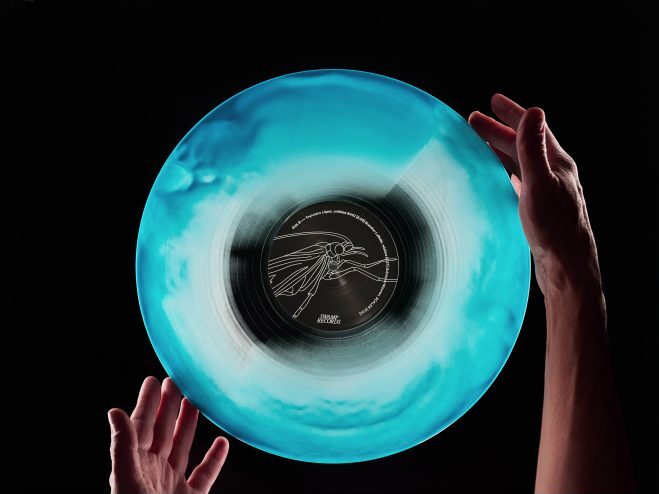
The work therefore extends the accompanying Amphibian Songs II LP beyond the recorded object into an immersive, responsive environment. The LP brings together compositions by Markus J. Buehler, Nicole L’Huillier, Brandon LaBelle, Grönlund-Nisunen, and Francisco López, exploring relationships among biological materials, vibration, listening, and ecological imagination. Amphibian Drift carries this inquiry into space, where sound is no longer only reproduced in time but becomes architectural, interactive, and navigable.
Ultimately, Amphibian Drift proposes XR as a medium not simply for visualization but for molecular and ecological imagination. It asks how artistic research might engage scientific discovery by transforming data into experience, and how complex systems might be understood differently when vibration, movement, listening, and spatial orientation become part of the inquiry. Rather than offering a definitive representation of the caddisfly protein, the work creates conditions for encountering it otherwise: as structure and vibration, model and environment, data and sound, biological material and perceptual event. In doing so, Amphibian Drift approaches knowledge not as something fixed within an image or dataset, but as something that can emerge through movement across scales, through relations among bodies, and through the act of listening.
Credits:
Concept and artistic direction: Nomeda & Gediminas Urbonas / Urbonas Studio, MIT ACT & MIT School of Architecture and Planning
Sound composition: Markus J. Buehler, MIT CEE; Department of Civil and Environmental Engineering, MIT
XR Development: Terry Kang, MIT BS’22 and Thomas Lee Harriett / Pyraloid Protein modelling: Wei Lu, MIT Laboratory for Atomistic and Molecular Mechanics
Poster Design: NODE Berlin Oslo
Supported by Northway Biotech
Produced by MIT Future Fest and MIT STUDIO.nano
Presented by MIT Museum, MIT Technology Review, and the MIT Morningside Academy for Design